

03 · Pillar
AI video analytics
Context-aware visual intelligence for detecting objects, interactions, behaviours and operational scenarios in real-world industrial environments.
Objects · interactions · scenarios
Most industrial sites are already covered by cameras and observed by almost nobody. AI video analytics is what turns that estate from a recording you consult after an incident into a source that is read continuously while the incident is still forming.
What intelligent video analytics is
Video analytics is the continuous machine reading of a camera feed to establish what is happening in it. The word that carries the weight is continuous: the difference between analytics and review is not the sophistication of the analysis but whether it happens while there is still time to act on the result.
The word intelligent, which the industry has worn thin, has a specific meaning here too. First-generation systems drew a line and fired when a pixel crossed it. That works in a car park at night and fails everywhere that people and vehicles are supposed to be moving, which is every operating industrial site, all day.
Why motion-based alerting fails at scale
The instinctive fix for unwatched cameras is to make them shout: trigger on motion, and let an operator judge. On a working site this produces an alert stream dominated by exactly the activity the site exists to perform, and the predictable outcome is that the alerts are muted, filtered down to nothing, or ignored.
The problem is not sensitivity, and no amount of tuning reaches it. Movement carries almost no information in an environment designed around movement. What carries information is whether the movement belongs: this vehicle, in this lane, at this hour, doing this. That is a question about context, and a trigger cannot ask it.
Objects, interactions and scenarios
Arkania structures video analytics across three dimensions. Objects are the first and the most familiar: people, vehicles, machinery, infrastructure, assets, animals. Interactions are the relationships between them, an operator approaching a machine, a vehicle entering a zone, a person handling a tool.
Scenarios are where operational meaning appears. A scenario is a combination of objects and interactions that means something in this specific environment: an unloading sequence performed out of order, an approach to a perimeter at an hour when nothing approaches, a plume where the same asset produced none yesterday. Almost nothing in an industrial environment is significant in isolation, which is why a system that stops at objects will always be a system someone has to interpret.
Scenario
People as a flow, not as faces
Occupancy, direction and queue length are properties of a zone and of a counting line, not of any individual crossing them. Nothing in this reading identifies anybody, and nothing in it needs to.
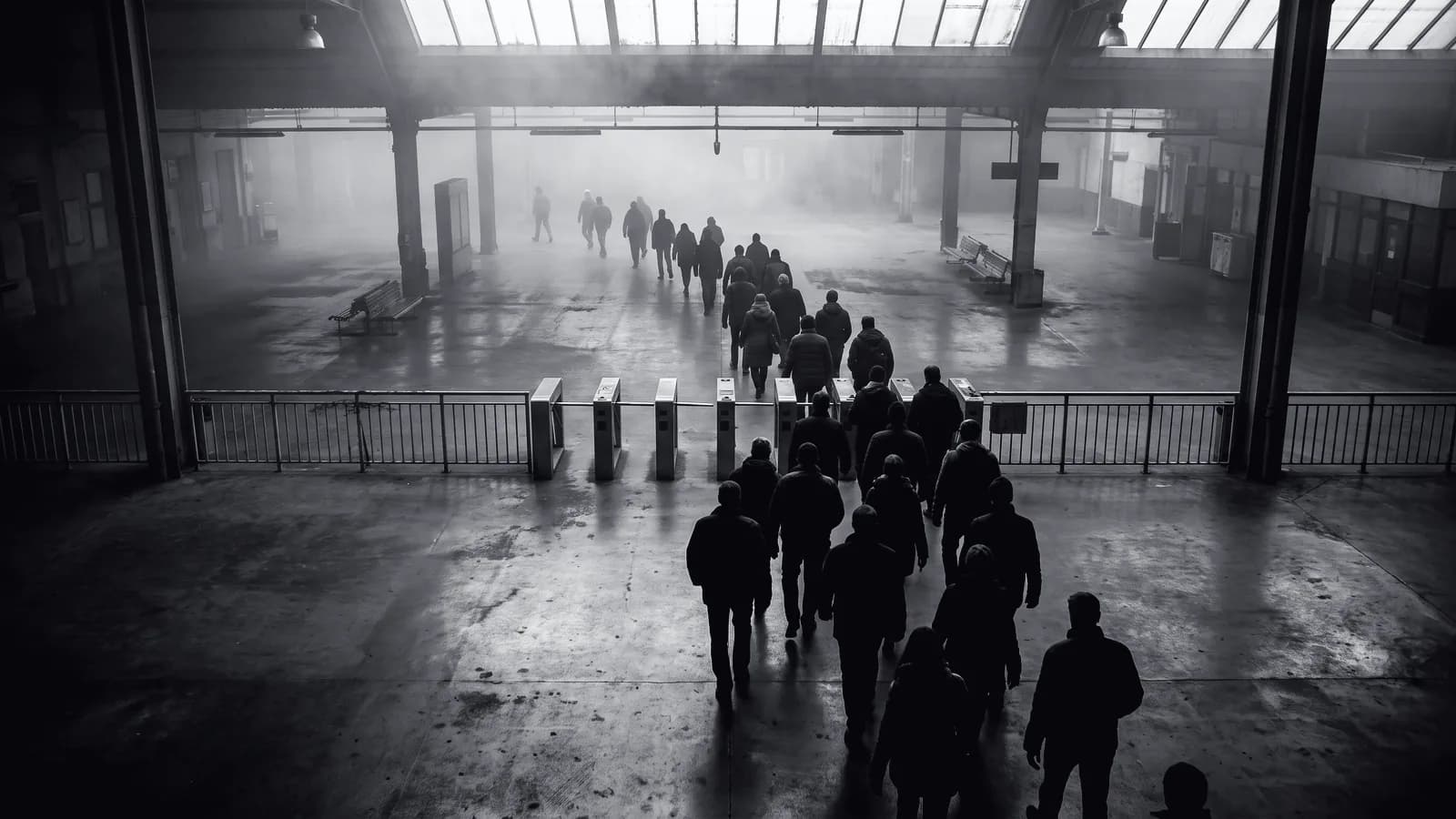
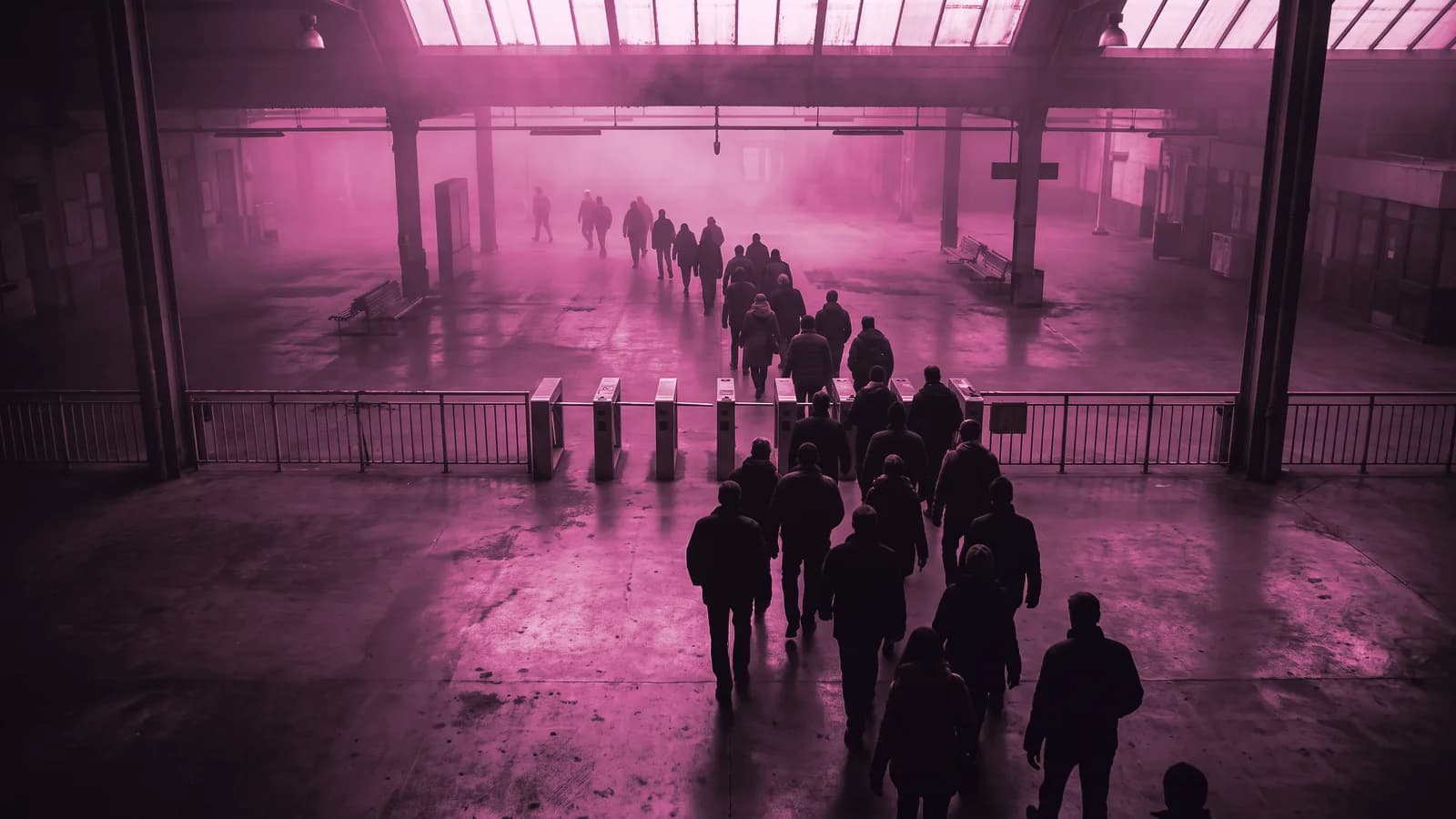
Illustrative analysis of this frame: Barrier, Zone, Queue, Crowd.
Detected regionsRegion, normalised frame coordinates
- 01BarrierObjectX 0.35 Y 0.51
- 02ZoneScenarioX 0.48 Y 0.51 A 14.4% ∠ −2°
- 03QueueScenarioX 0.52 Y 0.55
What the analytics reads
- 01Objects
- People, vehicles, machinery, infrastructure and assets, recognised across an existing camera estate.
- 02Interactions
- The relationships between them, approach, handling, entry, proximity, which is where most operational risk sits.
- 03Scenarios
- Combinations that mean something in this specific environment, including operational sequences and risk patterns.
- 04Anomalous behaviour
- Departure from an area's own established baseline, rather than from a rule written for somewhere else.
Scenario
A posture that has stopped changing
A person on the floor is not a different object from a person standing up. It is the same detection reporting a different state — which is why the mask traces the posture instead of bracketing the body, and why the second worker walking in is part of the reading.
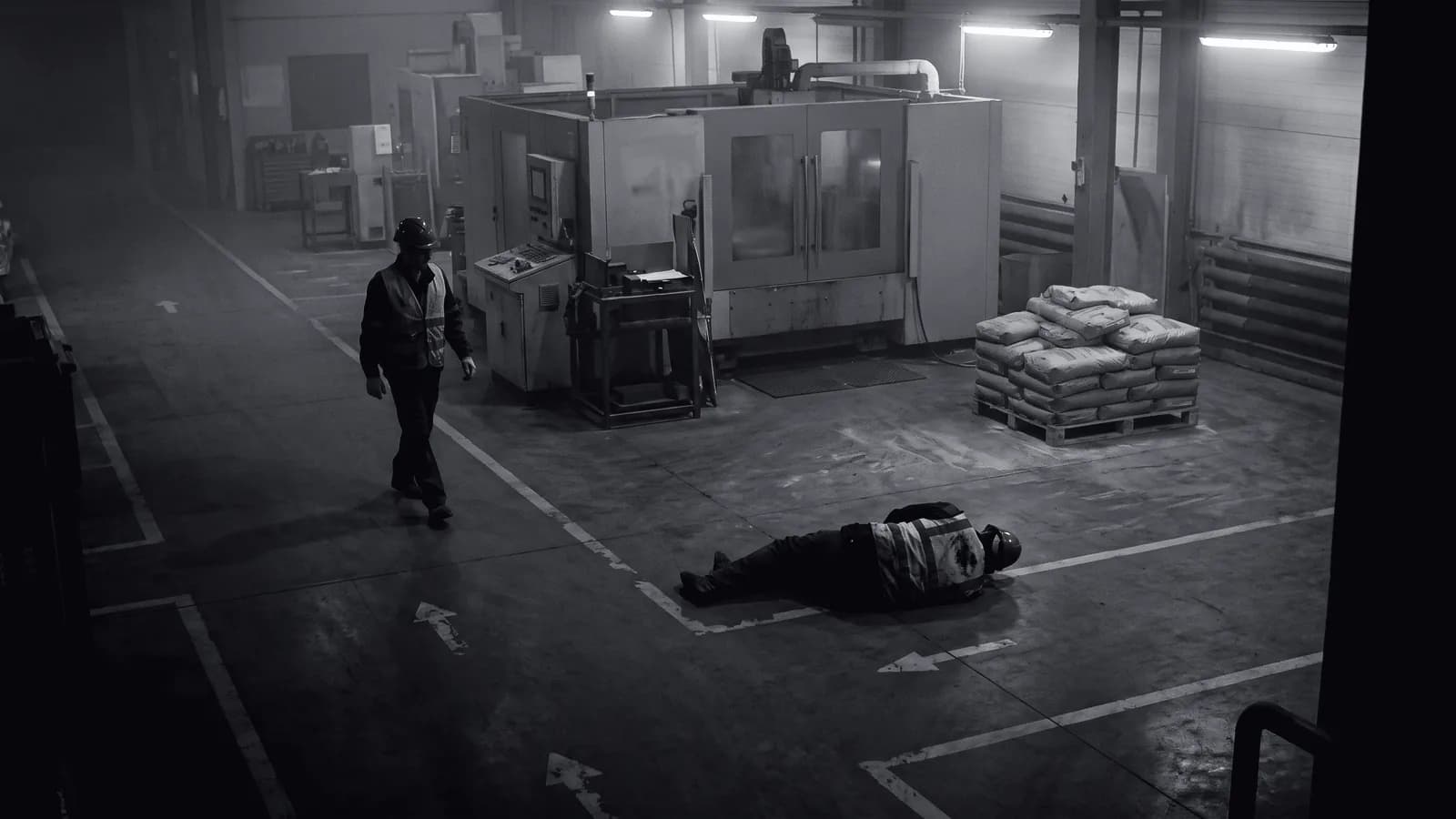
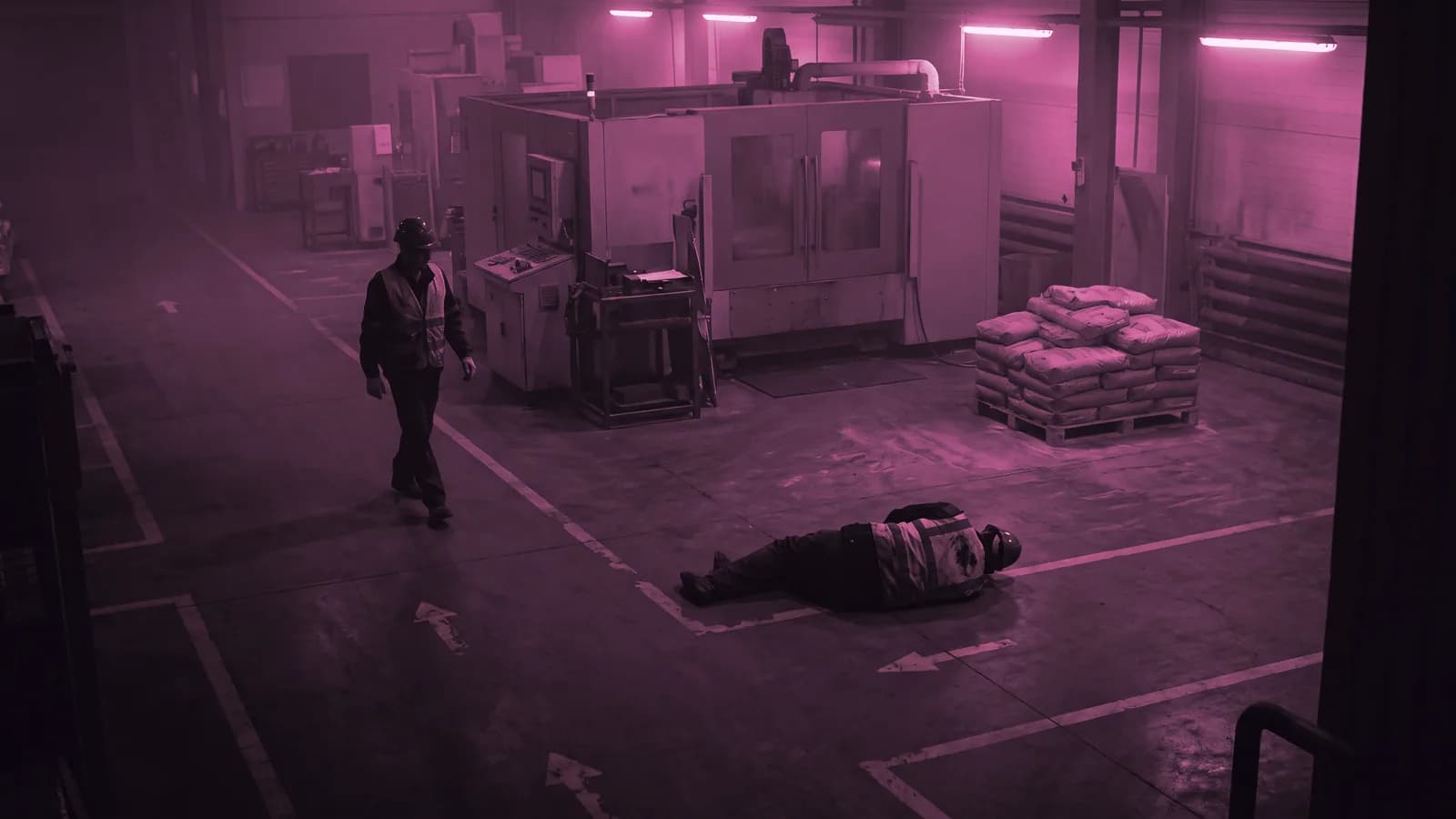
Illustrative analysis of this frame: Person down, Person, Machinery.
Detected regionsRegion, normalised frame coordinates
- 01Person downScenarioX 0.47 Y 0.60 A 1.6% ∠ +4°
- 02PersonObjectX 0.25 Y 0.27 A 1.6% ∠ +86°
- 03MachineryObjectX 0.31 Y 0.17 A 6.9%
Contextual understanding and anomalous behaviour
Anomaly is a comparison, and the only comparison that means anything is against the environment's own established baseline. A generic rule about after-hours presence is wrong on a site that runs three shifts; a generic rule about proximity is wrong in a bay where proximity is the job.
This is why models are specialised to an environment rather than configured for it. What is normal in a container yard at 03:00, in a turbine hall mid-maintenance or on a pipeline right-of-way during construction are three different normals, and none of them can be written down in advance by someone who has not seen the site.
Situational awareness in operating environments
The output of all of this is not a detection count. It is situational awareness: a continuously maintained picture of what is happening across an area larger than any individual can hold, delivered to the people responsible for it.
That picture has to be actionable rather than complete. A finding arriving with enough context to be judged, at a moment when judging it still changes something, is worth more than an exhaustive record of everything that moved, which is the form the same information takes when it arrives too late.
Deployment: on-premise, edge and private cloud
Video is the heaviest thing an industrial site produces, which makes where the analytics runs a practical question rather than a philosophical one. Streaming every camera to a central service is expensive where it is possible and impossible where it is not.
Arkania supports inference on-premise, at the edge on cameras, drones, robots and embedded devices, and in private or hybrid cloud, with integration into existing systems through SCADA, OPC UA, MQTT and M2M. Edge inference is what makes a remote or thinly connected site readable at all, and it is also what keeps operational imagery inside the client's control.
Where video analytics is deployed
The environments where camera coverage long ago outgrew the attention available to watch it.
Common questions about AI video analytics
What is AI video analytics?
The continuous machine reading of camera feeds to establish what is happening in them, structured around objects, the interactions between them and the scenarios those interactions form, rather than around whether a pixel changed.
How is it different from motion detection?
Motion detection answers whether something moved, which on an operating site is almost always yes. Video analytics asks whether what is happening is normal for this place at this time, which requires context that a trigger does not have.
Does it work with our existing cameras?
Yes. Working with the installed estate is a design requirement, and getting more from cameras already paid for is usually the point of the project.
Can the analytics run at the edge?
Yes, on cameras, drones, robots and embedded devices, as well as on-premise and in private or hybrid cloud. Edge inference is what makes remote and thinly connected sites practical to read continuously.
Does video leave our infrastructure?
Not unless the deployment is designed that way. Clients retain control over data flows, and models trained on their environment are owned by them.
Discuss a video analytics deployment
Tell us about the estate, the site and what an operator is expected to do with a finding.
Industrial and enterprise enquiries · EN / ES